



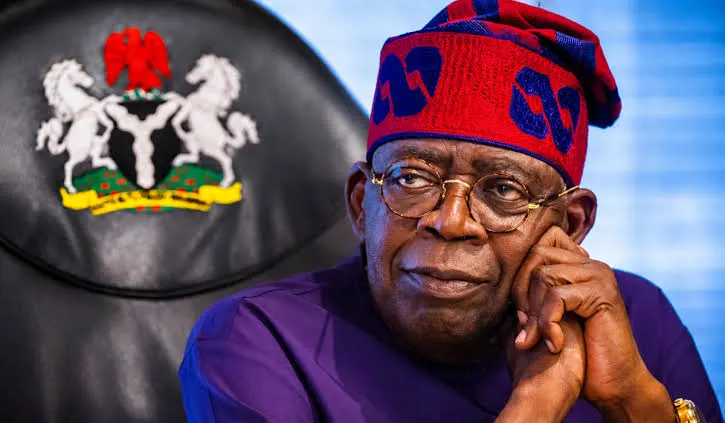
President Bola Ahmed Tinubu could record a major decline in support across Northern Nigeria in the 2027 presidential election and may secure less than 10 per cent of the region’s votes if the election is conducted freely and fairly, Convener of the League of Northern Democrats, Dr Umar Ardo, has predicted.
Ardo, who is also a prominent promoter of the All-Democratic Alliance (ADA), made the prediction during an exclusive interview on Frontline, a current affairs programme on Eagle 102.5 FM, Ilese-Ijebu, Ogun State.
He said the President’s performance at the polls in the North would largely depend on how voters assess his administration’s record, particularly on security, the economy, poverty and the rising cost of living.
According to Ardo, insecurity remains one of the most critical issues confronting Northern communities, with insurgency and other security threats continuing to disrupt farming, commerce and everyday life.
He argued that the security crisis could be substantially contained within a relatively short period if the government adopts an effective strategy and demonstrates sufficient political commitment.
“You can solve the issue of insecurity and insurgency in one year,” Ardo said.
He added that the effects of insecurity go beyond casualties and destruction of property, noting that farmers, traders and other economic actors cannot operate efficiently when their lives and livelihoods are constantly threatened.
Economic Reforms Under Fire
Ardo also faulted some of the major economic policies of the Tinubu administration, particularly the removal of fuel subsidy.
He questioned whether the policy had delivered meaningful benefits to ordinary Nigerians, given the increase in the cost of living and the erosion of household purchasing power.
“Subsidy removal, is it a benefit?” he asked.
The Northern political activist maintained that whatever salary increases had been implemented for some workers had not adequately offset the decline in the real value of their earnings.
“The purchasing power has been depreciated,” he said.
According to him, rising prices have made it increasingly difficult for Nigerians to meet basic needs, with the consequences more severe in Northern Nigeria because of the region’s large population of economically vulnerable citizens.
Ardo described the situation as a shift from widespread poverty to a deeper level of deprivation.
“The economic reform has pushed from the state of poverty to destitution,” he said.
Representation and Political Sentiment
The politician also raised questions about political representation under the Tinubu administration, arguing that the composition of government could influence how citizens perceive the fairness and inclusiveness of the administration.
He said the issue of representation should not be considered in isolation but alongside the broader performance of government, particularly the extent to which its policies have improved the lives of Nigerians.
Ardo argued that the 2027 presidential election would give Northern voters an opportunity to evaluate the administration based on their experiences since Tinubu assumed office.
He cautioned against assuming that the voting pattern recorded in the North during the 2023 presidential election would automatically be repeated in 2027.
Rather, he said, prevailing economic conditions, insecurity and the government’s overall performance would be central to the decisions of voters.
‘Tinubu Won’t Get 10%’
Assessing the President’s chances in the region, Ardo said Tinubu could suffer a dramatic loss of Northern support if the next presidential election meets the requirements of a credible democratic contest.
“If a free, fair and credible election is conducted in Nigeria, Tinubu can’t get 10 percent of the Northern part,” he declared.
The prediction sets the stage for a potentially intense struggle for Northern votes ahead of the 2027 presidential election.
Any significant decline in Tinubu’s support in the region could provide opportunities for opposition candidates seeking to build or consolidate their electoral bases across the North.
Former Vice President Atiku Abubakar, who is identified in the report as the presidential candidate of the African Democratic Congress (ADC), could draw on his established political support in the North-East.
The report also identifies the Peter Obi-Rabiu Kwankwaso ticket of the Nigeria Democratic Congress (NDC) as another potential beneficiary of any shift in Northern voting patterns, particularly given Kwankwaso’s political influence in Kano and parts of the North-West.
With the North historically playing a crucial role in determining the outcome of Nigeria’s presidential elections, the region’s response to Tinubu’s record could become one of the defining factors in the 2027 contest.