



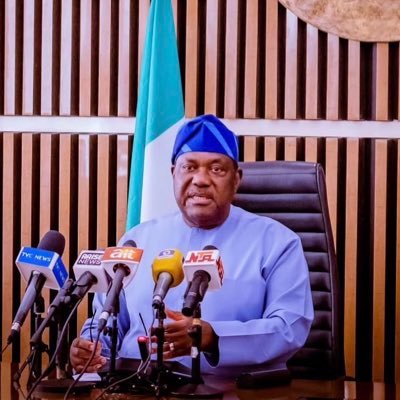
The Federal Government has reaffirmed its strong relationship with the Catholic Church, describing the institution as a key partner in Nigeria’s development while assuring Nigerians that the current economic challenges will ease as ongoing reforms begin to deliver lasting benefits.
Secretary to the Government of the Federation (SGF), Senator George Akume, made the clarification in a statement on Wednesday following public discussions generated by the recent meeting between President Bola Tinubu and leaders of the Catholic Bishops’ Conference of Nigeria (CBCN).
Akume said the Tinubu administration holds the Catholic Church in high esteem, acknowledging its longstanding contributions to education, healthcare, humanitarian services, peacebuilding and moral leadership across the country.
He noted that President Tinubu remains committed to maintaining open dialogue with faith-based organisations and other critical stakeholders as part of efforts to tackle national challenges.
According to the SGF, the government believes that sustainable national development requires collaboration among religious bodies, traditional institutions, civil society organisations, the private sector and citizens.
He stressed that constructive engagement with these groups remains essential for strengthening peace, national unity and social cohesion.
“The Federal Government deeply appreciates the Catholic Church’s enduring role in national development and welcomes sincere advice aimed at advancing the country’s progress,” Akume stated.
The clarification follows concerns raised by Catholic bishops during their meeting with President Tinubu over issues including the economy, insecurity, governance and political participation.
Akume explained that discussions between the President and the bishops were frank, respectful and productive, covering a wide range of national issues, including economic reforms, security, education, electoral integrity, public service delivery and religious freedom.
He emphasised that differing opinions expressed during the engagement should not be interpreted as a breakdown in the cordial relationship between the government and the Church.
According to him, both parties acknowledged areas where progress has been recorded, including the implementation of the Nigerian Education Loan Fund (NELFUND) and recent successes by security agencies in rescuing abducted schoolchildren and teachers.
On the economy, Akume admitted that many Nigerians are experiencing financial hardship but maintained that the reforms introduced by the Tinubu administration are necessary to correct long-standing structural imbalances and lay the foundation for sustainable economic growth.
He described the current difficulties as temporary, expressing confidence that ongoing investments in infrastructure, agriculture, power, healthcare and social intervention programmes would stimulate economic activity, create jobs and improve living standards.
The SGF highlighted major infrastructure projects, including the Lagos-Calabar Coastal Highway, the Sokoto-Badagry Super Highway, expanded rail networks and nationwide road construction, as strategic investments designed to boost connectivity and economic productivity.
He also pointed to government initiatives aimed at strengthening food security through improved agricultural support, mechanisation, expanded access to farm inputs and institutional interventions under the National Agricultural Land Development Agency (NALDA).
Akume further stated that reforms in the electricity and healthcare sectors are expected to enhance service delivery and support economic expansion.
He maintained that early indicators suggest the administration’s economic reforms are beginning to produce positive outcomes.
According to him, the foreign exchange market has become more stable, inflationary pressures are easing, macroeconomic fundamentals are improving and investor confidence is gradually returning.
The next phase of the reform programme, he added, will focus on translating these macroeconomic gains into lower living costs, quality employment opportunities, improved public services and broader economic inclusion.
Akume listed several intervention programmes—including the Social Investment Programmes, the Nigerian Consumer Credit Corporation (CreditCorp), NELFUND, business support initiatives and Conditional Cash Transfers—as measures designed to ensure that ordinary Nigerians benefit directly from the government’s reform agenda.
On security, the SGF acknowledged that protecting lives remains the administration’s foremost responsibility and expressed regret over every loss caused by terrorism, banditry, kidnapping and other violent crimes.
He disclosed that the government is strengthening the nation’s security architecture through the establishment of four new Army divisions in Benue, Kwara, Taraba and Edo states, alongside improvements in intelligence gathering, logistics, recruitment, personnel welfare and technology, as well as the creation of the Office of Homeland Security.
Addressing concerns about Nigeria’s democratic space, Akume dismissed allegations that the Tinubu administration is pursuing a one-party state, insisting that the government remains firmly committed to constitutional democracy, political pluralism and the independence of the Independent National Electoral Commission (INEC).
He cited INEC’s registration of 21 political parties as evidence that Nigeria’s democratic environment remains open, competitive and inclusive.
The SGF reaffirmed that the Tinubu administration would continue to engage with religious organisations and other national stakeholders while remaining receptive to constructive criticism and policy recommendations that promote national development and the welfare of Nigerians.